
 由 英语数字智库
The Garden of Forking Paths《小径分岔的花园》节选
作者:Jorge Luis Borges(豪尔赫·路易斯·博尔赫斯)
首次出版:1941 年 12 月 30 日
首次收录于:《El jardín de senderos que se bifurcan》《小径分岔的花园》
出版背景:阿根廷,以单行本短篇集形式推出
收录说明:后收录于小说合集《Ficciones》《虚构集》(1944)
创作背景:
这是博尔赫斯最知名的幻想短篇。
小说以一战间谍故事为外壳,
借一座不存在的迷宫与一本奇异手稿,
提出时间无限分叉、所有可能性并行共存的构想,
融合侦探叙事、玄学思辨与东方意象。
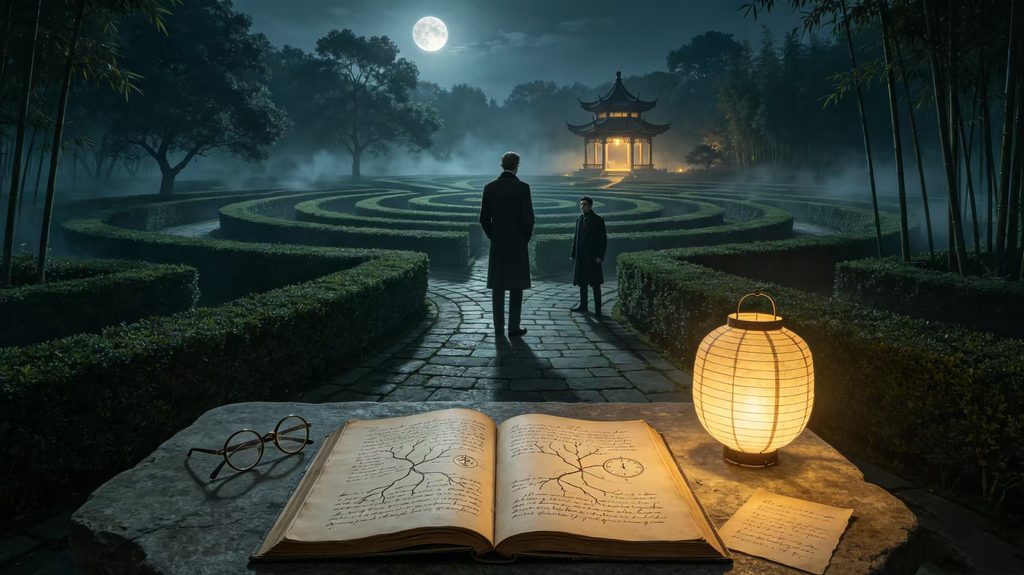
英文原文
I understood suddenly two things,
the first trivial, the second almost unbelievable:
the music came from the pavilion,
and the music was Chinese.
For precisely that reason
I had openly accepted it without paying it any heed.
I do not remember whether there was a bell
or whether I knocked with my hand.
The sparkling of the music continued.
From the rear of the house a lantern approached:
a lantern that the trees sometimes striped and sometimes eclipsed,
a paper lantern that had the form of a drum and the color of the moon.
A tall man bore it.
I did not see his face for the light blinded me.
He opened the door and said slowly, in my own language:
“I see that the pious Hsi P’eng persists in correcting my solitude.
You no doubt wish to see the garden?”
I recognized the name of one of our consuls
and I replied, disconcerted,
“The garden?”
“The garden of forking paths.”
Something stirred in my memory
and I uttered with incomprehensible certainty,
“The garden of my ancestor Ts’ui Pên.”
“Your ancestor? Your illustrious ancestor?
Come in.”
The damp path zigzagged like those of my childhood.
We came to a library of Eastern and Western books.
I recognized bound in yellow silk
several volumes of the Lost Encyclopedia,
which had been burned and then rewritten in the thirteenth century.
There was also the manuscript of Ts’ui Pên’s novel.
Stephen Albert was a calm, pale man with grey eyes.
He wore spectacles with round frames.
He held out his hand to me and said:
“Before we look at the garden,
I want to show you this manuscript.”
I took the thick bundle of yellowed pages.
The handwriting was delicate,
full of crossings-out and revisions.
Ts’ui Pên had written it in secret,
intending it to be a labyrinth.
No one had ever understood its meaning.
Men had searched for the garden for a hundred years,
yet no one had found it.
“Ts’ui Pên’s labyrinth,” Stephen Albert said,
“is not a physical maze of hedges and walls.
It is a book.”
I stared at him in confusion.
Albert went on quietly:
“A labyrinth is a riddle,
a sentence whose answer is hidden.
This book is a riddle whose answer is time.
It does not follow a single linear order.
Every time a character faces a choice,
the story splits into several futures.
Each branch leads to different outcomes,
and all of them exist at once.”
He pointed to a paragraph on the page.
“Look here.
In this line, a man may kill his enemy.
In another branch, the enemy kills him.
In yet another, both survive.
All these versions are true.
Time forks perpetually toward innumerable futures.”
A chill passed through my body.
I had come to this house to murder Stephen Albert.
His death would send a secret message to my German commander.
But now I stood listening to his explanation,
drawn into the strange, magnificent idea of forking time.
At that moment,
I heard the sound of footsteps on the gravel path outside.
It was the captain of the British police.
My mission pressed upon me again.
I knew I could not delay any longer.
My hand moved slowly toward the revolver hidden inside my coat.
译文
我忽然明白了两件事,
一件微不足道,另一件几乎令人难以置信:
乐声来自亭台之中,
而且是中国的乐曲。
正因为如此,
我方才听着,却没有放在心上。
我记不清是按了门铃,
还是抬手叩了门。
悠扬的乐声依旧回荡不止。
一盏灯笼从屋子深处缓缓靠近:
树木的影子时而划过灯笼,时而将它遮蔽,
那是纸糊的灯笼,形如鼓面,色如明月。
一个高个子男人提着它。
光线刺眼,我看不清他的面容。
他打开门,用我的母语缓缓开口:
“我看虔诚的崔朋,执意要来打破我的孤寂。
你想必是想看看那座花园吧?”
我认出这是我们一位领事的名字,
慌乱地答道:
“花园?”
“小径分岔的花园。”
记忆深处有什么东西被触动,
我带着一种难以解释的笃定脱口而出:
“是我祖先崔朋的花园。”
“你的祖先?那位赫赫有名的先祖?
请进。”
潮湿的小路蜿蜒曲折,像我儿时见过的小径。
我们走进一间藏满东西方典籍的书房。
我认出几册黄绢装订的《永乐大典》残卷,
这套典籍曾遭焚毁,在十三世纪被人重新缮写。
桌上还放着崔朋那部小说的手稿。
斯蒂芬·艾伯特面色沉静苍白,生着灰色眼眸。
他戴着圆框眼镜。
他向我伸出手说道:
“在参观花园之前,
我想先给你看一看这份手稿。”
我接过厚厚一叠泛黄纸页。
字迹纤细工整,
纸上满是涂改与增删的痕迹。
崔朋秘密写下这部书稿,
想要把它建成一座迷宫。
百年来,没有人读懂其中深意。
人们四处寻找那座花园,
却始终一无所获。
“崔朋的迷宫,”斯蒂芬·艾伯特说道,
“并不是由树篱与围墙搭建的实体迷宫。
它是一本书。”
我茫然地望着他。
艾伯特继续平静地诉说:
“迷宫本身就是谜题,
是藏着谜底的一句话。
这本书的谜底,就是时间。
它不遵循单一的线性顺序。
每当书中人物面临抉择,
故事就分裂成数条不同的未来。
每一条分支都通向不一样的结局,
而所有结局,同时真实存在。”
他指向稿纸上的一段文字。
“你看这里。
在这条时间线里,一个人杀死仇敌。
在另一条分支里,仇敌将他杀死。
还有一条分支,两人都活了下来。
所有版本全都成立。
时间持续不断地分岔,伸向无数种未来。”
一阵寒意掠过我的脊背。
我来到这里,本是要杀死斯蒂芬·艾伯特。
他的死,就是传递给德国上司的密报。
可此刻我静静站着,聆听他的解说,
深深沉浸在这套宏大又奇异的时间理论之中。
就在这时,
外面碎石小径上传来脚步声。
是英国警方的队长。
刺杀的任务重新压上心头。
我知道自己不能再拖延下去。
我的手慢慢伸向藏在外套里的左轮手枪。
🔍长难句赏析与拆解
原句一
From the rear of the house a lantern approached:
a lantern that the trees sometimes striped and sometimes eclipsed,
a paper lantern that had the form of a drum and the color of the moon.
句式解读
本句为倒装句,主干前置表画面感;
包含两个that引导的限制性定语从句,共同修饰先行词lantern。
用同位结构叠加定语从句,层层描绘灯笼,营造朦胧梦幻氛围。
句子主干
A lantern approached.
原句二
“A labyrinth is a riddle,
a sentence whose answer is hidden.
This book is a riddle whose answer is time.”
句式解读
两句均为whose引导定语从句,whose在从句中作定语,修饰先行词riddle。
用比喻句式把迷宫、谜题、时间绑定,是全文核心思辨句。
句子主干
A labyrinth is a riddle. This book is a riddle.
原句三
Every time a character faces a choice,
the story splits into several futures.
句式解读
本句为every time引导时间状语从句,
every time在这里相当于连词,引出时间条件。
简洁点明小说“时间分叉”的核心设定。
句子主干
The story splits into several futures.
📖全篇句式特点
文本大量使用定语从句、时间状语从句、同位语结构,
穿插倒装句来渲染氛围感。
长短句交错,冷静克制的陈述之下暗藏哲学思辨。
叙事表层是间谍追杀的紧张情节,
内层嵌套关于时间、可能性的抽象讨论。
典型的博尔赫斯叙事风格,
适合精读定语从句、名词性从句、比喻性长难句。
核心词汇
1. eclipse
/ɪˈklɪps/
遮蔽,使黯然失色
动词(v.)
2. illustrious
/ɪˈlʌstriəs/
声名显赫的,杰出的
形容词(adj.)
3. zigzag
/ˈzɪɡzæɡ/
曲折前进,蜿蜒
动词(v.)
4. manuscript
/ˈmænjuskrɪpt/
手稿,原稿
名词(n.)
5. perpetual
/pəˈpetʃuəl/
永久的,持续不断的
形容词(adj.)
6. innumerable
/ɪˈnjuːmərəbl/
无数的,数不清的
形容词(adj.)
7. gravel
/ˈɡrævl/
碎石,砂砾
名词(n.)
8. revolver
/rɪˈvɒlvə(r)/
左轮手枪
名词(n.)
9. conceal
/kənˈsiːl/
隐藏,藏匿
动词(v.)
10. perpetually
/pəˈpetʃuəli/
持续地,永远地
副词(adv.)
📜文学赏析
《小径分岔的花园》是博尔赫斯幻想文学的标杆之作。
选文将间谍故事和玄学幻想融为一体。
主人公俞琛身负刺杀任务,
却在艾伯特的书房里,窥见崔朋手稿里关于分叉时间的秘密。
博尔赫斯跳出传统单一时间线,
提出一种平行时间观:
选择不会取消别的可能性,
所有分支同时并存,所有结局同样真实。
花园不是园林,迷宫不是高墙,
真正的迷宫是时间本身。
故事自带双重张力:
一边是现实里紧迫的刺杀任务,
一边是超越现实、浩瀚无穷的时间宇宙。
现实的暴力与抽象的哲思交织在一起,
形成独属于博尔赫斯的冷峻、空灵的文学气质。
💡主旨品读
选文以间谍任务为表层线索,
借崔朋的奇异手稿,探讨时间的本质。
我们总习惯认为时间只有一条轨道,
过去不可更改,未来只有一种。
而在崔朋的观念里,
每一次选择都会打开新的时间分支,
无数世界并行生长。
博尔赫斯借这个奇幻构想告诉读者:
现实只是无数可能性当中的其中一条路径。
所有遗憾、别的选择、另一种人生,
都在别的时间分支里真实发生。
这篇小说也因此成为后世平行宇宙、非线性叙事思想重要的文学源头。
©英语数字智库 版权所有
未经权利人许可,不得转载、摘抄、复制、
二次编辑或商用分发,违者将依法追究法律责任。
请点击返回首页收录经典目录