
 由 英语数字智库
了解更多:雅思:常规本意&熟词僻义目录
The Hunchback of Notre‑Dame《巴黎圣母院》节选
作者:维克多·雨果(Victor Hugo)
首次出版:1831 年 3 月 16 日
首次发表刊物:Gosselin(巴黎)
出版背景:法国原版刊印,后世多次校勘再版。
多国译本与双语选编版本广泛流传。
收录说明:该版本为原著定本节选,
以巴黎圣母院为舞台,串联起卡西莫多、
爱斯梅拉达与克洛德等人的命运纠葛。
美与丑、善与恶在哥特古城里激烈碰撞,
充满浪漫主义的悲剧力量。
创作背景:
当时巴黎古建筑遭到破坏,
雨果借这本书呼吁保护历史古迹,
同时批判虚伪的宗教与残酷的社会偏见。
英文原文
The great bells of Notre‑Dame rang loud across old Paris on the day of the Feast of Fools.
Crowds flooded the narrow streets around the cathedral.
Laughter, shouts and music filled the crisp winter air.
Every citizen, rich or poor, came to join the wild, joyful celebration.
The main contest of the day was to choose the Pope of Fools.
Whoever wore the ugliest, most terrible face would win the crown.
Many men stepped forward to show their twisted masks and painted grimaces.
The crowd cheered and laughed, but none could truly amaze them.
Then a strange figure appeared at the window of the hall.
It was Quasimodo, the bell‑ringer of Notre‑Dame.
He had no need of a false mask.
His face was ugly by nature: one eye buried under a huge humped forehead,
a crooked nose, thick swollen lips, and a body bent by a terrible hunchback.
He was deaf from years of ringing the heavy bronze bells high in the tower.
When the crowd saw his face, their cheers exploded.
No face in all Paris could compete with his.
They placed a paper crown upon his head,
draped a ragged robe over his shoulders,
and carried him through the streets in a rough wooden chair.
Quasimodo could not hear their shouts,
but he could see their excited faces and waving hands.
A dull, confused joy stirred inside him.
For the first time in his lonely life, so many eyes turned toward him, not in fear.
In the middle of the noisy parade, a young woman stepped out from the crowd.
She was Esmeralda, the beautiful Roma dancer.
She carried a small white goat named Djali,
and she wore a simple bright costume for her street performance.
Her dark eyes shone softly, and her movements were light and graceful.
When she saw Quasimodo being paraded, she watched him with pity, not disgust.
Soon the crowd’s mood changed.
Claude Frollo, the archdeacon of Notre‑Dame, pushed through the people.
He was Quasimodo’s guardian,
the man who had taken him in when he was an abandoned baby.
Frollo’s face was cold and stern.
He hated this foolish celebration, and he hated the attention given to Quasimodo.
With a sharp command, he broke up the parade,
tore the crown from Quasimodo’s head, and sent the crowd away.
Quasimodo bowed his head obediently.
He feared Frollo deeply, for this priest was the only master he had ever known.
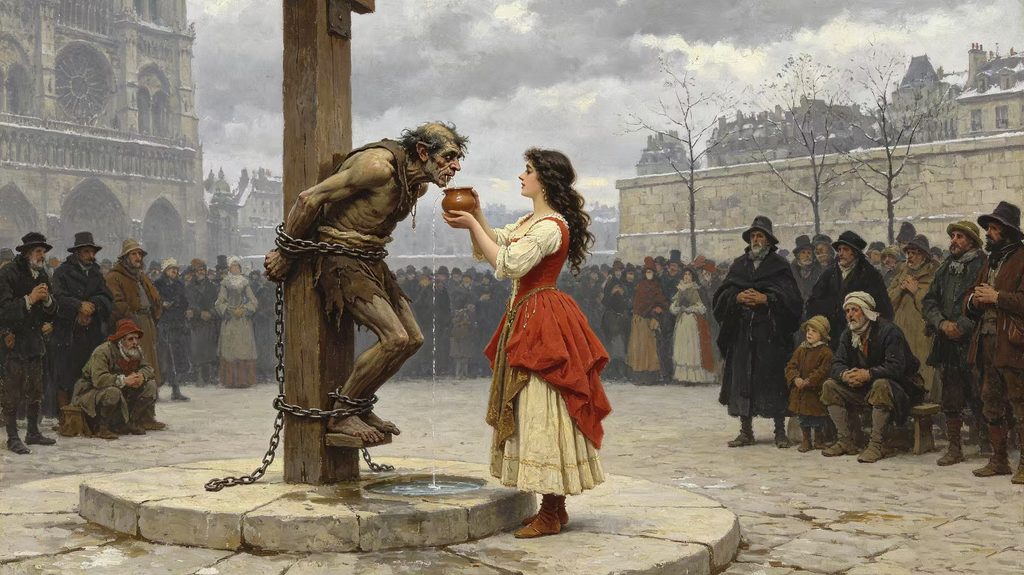
As evening fell, Quasimodo grew thirsty.
The crowd that had cheered him a short time before now mocked and threw stones at him.
He was tied to the wooden pillory in the public square.
The pain burned in his throat.
He cried out for water again and again,
but the onlookers only laughed and threw rubbish.
No one showed him kindness.
Then Esmeralda walked slowly across the square.
She held a clay cup filled with fresh water.
Ignoring the angry shouts of the crowd,
she stepped up to the pillory and lifted the cup to Quasimodo’s dry lips.
Quasimodo stared at her in shock.
Tears rolled down his deformed cheeks.
All his life, people had only screamed, fled, or struck him.
No one had ever offered him gentle care.
He drank the water slowly,
and his heart, hard and closed for so long, began to soften.
He whispered a quiet “thank you”, a sound rough and broken.
From that moment on, this kind dancer became the only bright light in his dark world.
He did not understand the dangerous desire growing inside Frollo for Esmeralda.
He could not see the cruel fate waiting for the girl.
He only knew one simple truth:
among all the thousands of people in Paris,
she alone had looked at him with mercy.
The great stone walls of Notre‑Dame stood watching over them,
silent witnesses to the gap between outward beauty and inner goodness.
译文
愚人节这天,
巴黎圣母院洪亮的钟声响彻古老的巴黎城。
大教堂四周狭窄的街道上挤满了人群。
欢笑声、叫喊声与乐曲声飘荡在清冷的冬日空气里。
无论贫富,全城百姓都赶来参加这场热闹狂欢。
当天最重要的活动,是选出愚人之王。
谁扮出最丑陋、最骇人模样,谁就能戴上王冠。
许多人走上前,展示扭曲的面具、画出来的鬼脸。
人群欢呼大笑,却没有一个人真正震撼全场。
这时,大厅窗口出现一个奇特的身影。
他是卡西莫多,圣母院的敲钟人。
他根本不需要假面。
他的丑陋与生俱来:
一只眼睛埋在高高隆起的额头之下,
鼻子歪斜,嘴唇肥厚肿胀,脊背因严重驼背而弯曲。
常年在高塔上敲打沉重的青铜巨钟,他早已失去听觉。
当人群看见他的面容,欢呼声瞬间爆发。
整个巴黎,再也找不出能胜过他的面孔。
人们把纸王冠戴在他头上,
给他披上破旧长袍,
用简陋木椅抬着他在街上游行。
卡西莫多听不见喧闹的呼喊,
但他看得见人们激动的神情、挥舞的双手。
一丝懵懂又茫然的喜悦在心底泛起。
在孤单的一生中,这是第一次,
无数目光投向他,而不是满怀恐惧。
喧闹的游行队伍中间,一位年轻姑娘从人群里走出来。
她是爱斯梅拉达,美丽的吉普赛舞女。
她身边跟着一只名叫加里的小白山羊,
一身简洁鲜亮的服饰,准备街头表演。
深色眼眸温润明亮,身姿轻盈优雅。
看见被众人簇拥游行的卡西莫多,
她眼中流露的是同情,而非厌恶。
没过多久,人群的气氛骤然转变。
圣母院副主教克洛德·弗罗洛拨开人群走了过来。
他是卡西莫多的监护人,
当年捡到被遗弃的婴儿,将他收养长大。
弗罗洛神情冷峻肃穆。
他厌恶这场荒唐庆典,也厌恶卡西莫多收获这么多关注。
他厉声喝止游行,一把扯下卡西莫多头上的王冠,驱散人群。
卡西莫多顺从地低下头。
他深深畏惧弗罗洛,这位神父是他唯一的主人。
夜幕降临,卡西莫多口干舌燥。
方才还为他欢呼的人群,此刻纷纷嘲弄他,朝他扔石块。
他被绑在广场的耻辱柱上示众。
喉咙灼烧般干渴。
他一遍又一遍呼喊想要喝水,
围观的人却只知道哄笑,朝他抛掷垃圾。
没有一个人愿意施以善意。
这时爱斯梅拉达缓步穿过广场。
她手里捧着盛满清水的陶杯。
不顾周遭嘈杂的起哄声,
她走到耻辱柱前,将水杯送到卡西莫多干裂的唇边。
卡西莫多震惊地凝望着她。
泪水顺着畸形的脸颊滑落。
从小到大,世人对他只有尖叫、躲避、殴打。
从来没有人这样温柔善待他。
他慢慢喝下水,
长久封闭坚硬的心,开始慢慢柔软。
他发出沙哑破碎的声音,低声说了一句谢谢。
从这一刻起,这位善良的姑娘,成了他黑暗世界里唯一的光。
他还不知道,弗罗洛心中正在滋生对爱斯梅拉达危险的占有欲。
他预见不到等待少女的残酷命运。
他只明白一件简单的事:
在巴黎成千上万的人当中,
唯有她,用怜悯看待自己。
圣母院巨大的石墙静静伫立,注视着这一切,
默默见证外在容貌与内心良善之间巨大的鸿沟。
🔍长难句赏析与拆解
原句:
When the crowd saw his face, their cheers exploded.
No face in all Paris could compete with his.
They placed a paper crown upon his head,
draped a ragged robe over his shoulders,
and carried him through the streets in a rough wooden chair.
句式解读:
when引导时间状语从句,
连续三组并列谓语placed、draped、carried,动作一气呵成;
短句节奏明快,烘托狂欢喧闹的场面。
句子主干:
Their cheers exploded.
No face could compete with his.
They placed a crown, draped a robe and carried him.
原句:
He was deaf from years of ringing the heavy bronze bells high in the tower.
句式解读:
from引出原因状语,
ringing是动名词;
high in the tower作后置地点修饰,
简洁交代卡西莫多耳聋的根源。
句子主干:
He was deaf.
文学赏析
《巴黎圣母院》是雨果1831年出版的浪漫主义经典小说。
本段选取愚人节狂欢、卡西莫多受辱、
爱斯梅拉达送水这个核心经典片段,是全书重要的转折点。
雨果在这里抛出全书核心对照命题:
外在容貌的美与丑,和灵魂的善与恶并不对等。
卡西莫多外表丑陋骇人,内心纯粹感恩;
爱斯梅拉达容貌明艳,心底悲悯柔软;
而衣冠庄重的副主教弗罗洛,内里藏着扭曲黑暗的欲望。
热闹的愚人节狂欢和之后耻辱柱上的折磨形成强烈反差。
前一秒众人追捧卡西莫多,下一秒就肆意欺凌,
写出民众盲目、善变、容易被情绪裹挟的特点。
一杯清水是全文极具象征意义的情节,
这份微小的善意,唤醒了卡西莫多沉睡的温情,
也埋下后续所有悲剧与守护故事的伏笔。
写作迁移点拨
适合写作主题:外表与本心、美丑的定义、同情与善良、人性的复杂、偏见。
高分仿写:
True beauty never lives in the shape of one’s face,
but in the kindness hidden deep inside the heart.
仿写运用:
适合议论文探讨何为真正的美,破除以貌取人的偏见。
📖全篇句式特点
长短句交错,描写画面感极强;
状语从句、并列谓语大量使用。
文字浪漫富有画面感,贴合雨果浪漫主义文风,
用词难度适中,适合英文精读讲义。
先铺写喧闹欢快的节日氛围,再转向羞辱、冷漠,
最后落在送水带来的温暖冲击,情绪起伏层次清晰。
核心词汇
1. cathedral
/kəˈθiːdrəl/
大教堂
名词 (n.)
2. hunchback
/ˈhʌntʃbæk/
驼背;驼背的人
名词 (n.)
3. guardian
/ˈɡɑːdiən/
监护人,保护人
名词 (n.)
4. pillory
/ˈpɪləri/
耻辱柱
名词 (n.)
5. mock
/mɒk/
嘲弄,讥笑
动词 (v.)
6. mercy
/ˈmɜːsi/
怜悯,仁慈
名词 (n.)
7. bronze
/brɒnz/
青铜
名词 (n.)
8. abandon
/əˈbændən/
遗弃,抛弃
动词 (v.)
9. parade
/pəˈreɪd/
游行,列队行进
名词 (n.)
10. deform
/dɪˈfɔːm/
使变形,使畸形
动词 (v.)
💡主旨品读
这一段告诉我们:评判一个人,不能依靠外貌。
世人第一眼就被卡西莫多丑陋的外表吓到,
只有爱斯梅拉达,越过可怖的长相,看见他的痛苦。
大多数人所谓的喜欢是肤浅短暂的:
狂欢时拿他取乐,落难时便肆意伤害。
这份在众人冷眼之中送出的清水,
代表不带有功利的同情,也是全书最动人的地方。
雨果借着圣母院古老的石头建筑见证这一切,
提醒读者:看得见的容貌会欺骗人,
只有发自内心的善良,才是永不褪色的美好。
©英语数字智库 版权所有
未经权利人许可,不得转载、摘抄、复制、
二次编辑或商用分发,违者将依法追究法律责任。
请点击返回首页收录经典目录