
 由 英语数字智库
了解更多:考研英语:伦理道德价值观词汇目录
A Christmas Carol《圣诞颂歌》
作者:查尔斯·狄更斯(Charles Dickens)
首次出版:1843 年 12 月 19 日
首次发表刊物:单行本出版
出版背景:英国原版刊印,后世多次校勘再版。
多国译本与双语选编版本广泛流传。
收录说明:
故事主角是冷酷吝啬的商人斯克鲁奇。
他眼里只有金钱,拒绝温情,厌恶圣诞节。
圣诞前夜,三只幽灵依次拜访,
带他看见过去、现在与未来。
一幕幕景象刺痛他冰冷的心,让他幡然醒悟。
他终于放下贪婪,学会慷慨、仁爱与体谅他人。
创作背景:
当时英国工业化快速推进,贫富差距不断拉大。
狄更斯想用温暖的故事唤醒世人。
提醒大家,真正珍贵的不是财富,是爱与善意。
英文原文
Marley was dead,
to begin with.
There was not the smallest doubt about this fact.
The clergyman,
the clerk,
the undertaker,
and the chief mourner
had all put their signatures on the burial register.
Scrooge had signed it too.
In the business world of London,
Scrooge’s signature carried weight,
and whatever he set his name to was trusted by merchants on the Exchange.
Old Jacob Marley was dead,
as dead as a solid iron door‑nail.
Scrooge had worked alongside Marley,
as his only business partner,
for seven long decades of hard trade.
They shared one narrow, cold office year after year,
counted gold together,
chased profit without pause,
and cared for little else in the whole wide world.
When Marley drew his last breath,
Scrooge did not feel grief.
He only thought carefully about the settlement of accounts,
and made sure every debt and asset was sorted neatly.
After that,
Scrooge became the sole master of their firm.
Yet wealth never softened his heart.
He remained a tight‑fisted,
bitter,
lonely old miser.
Nothing pleased him more than seeing his piles of coins grow larger.
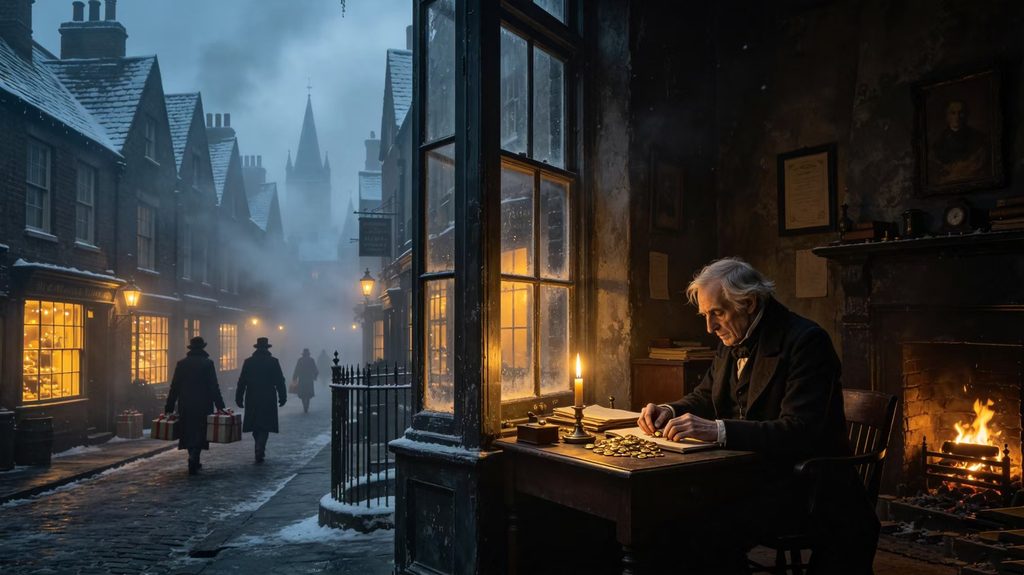
The winter fog hung thick over the whole city on Christmas Eve.
A sharp, freezing wind swept through narrow streets,
and frost clung to every window and wooden wall.
Still,
the cold air outside could never compare
to the icy indifference locked deep inside Scrooge’s chest.
Snow fell soft and heavy,
but it was not half as heavy as his selfishness.
The bitter wind cut sharply at passers‑by,
yet it was gentler than Scrooge’s sharp, unkind words.
All over the town,
ordinary people were wrapped up in Christmas joy.
Families hurried home with baskets of food and small gifts.
Children laughed as they ran through the fog,
calling out cheerful greetings to strangers.
Shop windows glowed with warm candlelight,
and the smell of roasted meat and sweet pudding drifted along the road.
Every heart seemed ready to welcome kindness,
sharing what little they owned with neighbours and the poor.
Inside Scrooge’s dark office,
none of this warmth could reach him.
He kept his clerk Bob Cratchit in a tiny corner,
with only a handful of coal for his fire.
The clerk shivered under a thin scarf,
trying to warm himself by the faint flame of a candle.
Scrooge guarded the coal box closely,
and would not allow one extra piece of fuel to be burned.
Then Scrooge’s nephew Fred pushed open the office door.
His cheeks were red from the frost,
and his eyes shone with happiness.
“A merry Christmas, uncle!
God save you!” he called brightly.
Scrooge looked up and snapped,
“Bah! Humbug!”
Fred tried to persuade his uncle,
telling him Christmas was a gentle, precious season,
a time to forgive,
to love,
and to remember those we hold dear.
But Scrooge refused to listen.
He argued that Christmas was nothing but a waste of time and money.
He said it brought no profit,
only empty pleasure for lazy, foolish folk.
Soon after,
two kind gentlemen came in,
collecting money to feed and shelter poor hungry people over the holiday.
They asked Scrooge for a donation.
Scrooge refused them flatly.
He declared that the poor ought to go to workhouses or prisons,
and he would not give away a single penny to help them.
When Bob Cratchit asked for a day off to spend Christmas with his family,
Scrooge complained loudly.
He agreed at last,
but warned the clerk to come back early the next morning,
without delay.
As daylight faded away,
Scrooge closed his books and walked back to the old, gloomy house
that had once belonged to Marley.
He had no idea that this quiet Christmas Eve
would bring strange, terrible visitors.
The chains Marley had forged in life,
link by link from greed and selfishness,
would soon appear before his eyes,
and force Scrooge to face the empty, wasted life he had chosen for himself.
译文
先说一件无可争辩的事实,
马利已经死了。
这件事不存在一丝一毫的疑点。
牧师、文书、殡葬承办人,
还有主要送葬的亲友,
全都在葬礼登记簿上签下了名字。
斯克鲁奇也在上面签了字。
在伦敦的商界之中,
斯克鲁奇的签字拥有分量,
凡是他署名确认的文书,
交易所里的商人都会信以为真。
老雅各布·马利确确实实死了,
如同冰冷坚固的门钉一般,再无生机。
长久以来,
斯克鲁奇和马利一直搭档做生意,
是彼此唯一的合伙人,
一同熬过漫长艰辛的岁月。
他们常年挤在一间狭小阴冷的办公室里,
一起清点金银,
无休止追逐利益,
在这世上几乎不在乎别的任何事物。
马利咽下最后一口气的时候,
斯克鲁奇心中没有悲伤,
只冷静盘算账目清算,
仔细核对每一笔债权与资产。
自此之后,
生意完全归斯克鲁奇一人掌控。
可财富从来没有软化他的心肠。
他依旧吝啬刻薄、满心怨怼、孤身一人,
是一个守财的老吝啬鬼。
唯有看着自己的钱财越积越多,
他才会感到一丝满足。
圣诞前夜,
浓雾笼罩整座城市。
凛冽寒风穿梭在狭窄街巷,
白霜附着在每一扇窗户、每一面木墙之上。
但外面刺骨的寒意,
远远比不上封存在斯克鲁奇心底的冷漠。
大雪纷纷扬扬,
可这份沉重,远不及他深重的自私。
寒风刮得路人瑟瑟发抖,
却也比斯克鲁奇尖酸无情的话语要温和几分。
城里各处,
普通百姓都沉浸在圣诞的欢愉之中。
家家户户提着食物、抱着小礼物匆匆归家。
孩子们在雾气里奔跑欢笑,
对着路人送上欢快的祝福。
商店橱窗里烛光融融,
烤肉与甜布丁的香气,
沿着街道四处飘散。
人人心中都愿意释放善意,
愿意把自己仅有的东西,
分给邻居与穷苦之人。
但这份温暖,
怎么都透不进斯克鲁奇昏暗的办公室。
他的职员鲍勃·克拉奇特挤在小小的角落,
炉子里只有寥寥几块煤炭。
职员裹着单薄围巾瑟瑟发抖,
只能靠着微弱烛光勉强取暖。
煤炭箱牢牢握在斯克鲁奇手里,
绝不允许多添一块燃料。
就在这时,
斯克鲁奇的外甥弗雷德推开了房门。
寒霜冻红了他的脸颊,
眼里满是明亮的喜悦。
“圣诞快乐,舅舅!
愿上帝保佑您!”他欢快地喊道。
斯克鲁奇抬眼冷冷呵斥:
“呸!骗人的把戏!”
弗雷德耐心劝慰舅舅,
告诉他圣诞是温柔珍贵的时节,
是宽恕、爱人、惦念亲人的时刻。
但斯克鲁奇听不进去。
他坚持认为圣诞节纯粹是浪费钱财、虚度光阴,
带不来半点收益,
只是一群闲人愚蠢的消遣。
没过多久,
两位和善的绅士登门,
前来募集善款,
希望在节日里给饥寒交迫的穷人送去食物与庇护。
他们请求斯克鲁奇捐助一点钱财,
被斯克鲁奇一口回绝。
他声称穷人就该去济贫院或者监狱,
一分钱都不会拿出来接济他们。
鲍勃·克拉奇特向他请求休假一天,
回家和家人共度圣诞,
斯克鲁奇大发牢骚。
他勉强应允,
却严厉警告职员第二天一早必须准时回来,
不得迟到。
天色渐渐暗下,
斯克鲁奇合上账本,
走回那栋曾经属于马利的阴郁老宅。
他完全没有料到,
这个平静的圣诞前夜,
即将迎来诡异又可怕的访客。
马利生前用贪婪和自私一环一环打造的锁链,
很快就会出现在他眼前,
逼迫斯克鲁奇直面自己亲手选择的、空洞荒芜的人生。
🔍长难句赏析与拆解
原句一
The winter fog hung thick over the whole city on Christmas Eve.
A sharp, freezing wind swept through narrow streets,
and frost clung to every window and wooden wall.
Still,
the cold air outside could never compare
to the icy indifference locked deep inside Scrooge’s chest.
句式解读
本句为并列复合句,包含对比状语结构,
是描写环境、烘托人物内心的经典句型。
1. 前两句写景,交代圣诞前夜大雾、寒风、寒霜的环境,
用外部严寒铺垫氛围;
2. the cold air outside could never compare to the icy indifference
形成隐喻对比,把外在寒冷和斯克鲁奇内心的冷漠对照;
3. 以环境衬托人物性格,是文学阅读、读后续写环境烘托心理的高分写法。
句子主干:
The cold air outside could never compare to the icy indifference inside Scrooge’s chest.
原句二
He declared that the poor ought to go to workhouses or prisons,
and he would not give away a single penny to help them.
句式解读
本句为并列宾语从句复合句,省略一处引导词that,适合表达固执人物的观点态度。
1. that the poor ought to go to workhouses or prisons
是宾语从句,承接动词declared,引出斯克鲁奇冷漠的主张;
2. 后半分句并列,进一步强化他不愿施舍、拒绝善意的态度;
3. 句式直白有力,适合塑造冷酷、固执的人物形象。
句子主干:
He declared that the poor ought to go to workhouses or prisons,
and he would not give away a penny.
文学赏析
《圣诞颂歌》是狄更斯最家喻户晓的短篇故事,
这段节选取自故事开篇,
用层层铺展的画面,
搭建起整个故事的底色与矛盾。
狄更斯没有一上来直接说教,
先用浓雾、寒风、霜冻勾勒伦敦圣诞前夜的景象。
全城洋溢分享与温情的时候,
唯独斯克鲁奇活在隔绝一切温暖的世界里。
外面越是热闹柔软,
越反衬出他内心冰封的孤寂。
作者细致刻画几组对照人物:
热忱开朗的外甥弗雷德,
忍饥受冻却依旧本分善良的职员鲍勃,
心怀悲悯、主动募捐的绅士,
全部和吝啬刻薄的斯克鲁奇形成强烈反差。
他手握财富,
却不肯分出一丝暖意;
他拥有充足的钱财,
却认定穷苦人不值得同情,
把救济看作毫无意义的消耗。
马利的伏笔藏在开篇的文字之中。
马利生前和他一样追逐钱财、漠视善意,
死后被沉重锁链束缚,
这就是给斯克鲁奇敲响的警钟。
财富本身没有过错,
可如果一个人一生只追逐金钱,
丢掉怜悯、善意、温情,
最后困住自己的,
就是亲手打造的枷锁。
狄更斯用通俗鲜活的叙事,
写透维多利亚时代贫富差距的现实。
圣诞不只是节日狂欢,
更是提醒世人:
人活着不能只算利益账本,
还要记得共情弱者、善待身边之人。
这段平静的开篇,
藏着后续鬼魂造访、斯克鲁奇灵魂救赎的全部伏笔。
写作迁移点拨
适合写作主题:金钱与善良、共情与冷漠、救赎、
善待弱者、节日的意义、放下执念、人性的温度。
高分仿写
We may gather plenty of wealth in our life,
but true richness never lies in piles of gold.
It lives in kindness we give to others,
and the warm connections we build with people around us.
仿写运用
模仿原文“外物环境和内心性格对比”的写法,
适合议论文观点表达、读后续写人物转变,
适合关于财富、善良、人性类主题升华。
📖全篇句式特点
狄更斯典型维多利亚文风,
写景句子舒缓绵长,对话简短尖锐。
擅长环境烘托人物心境,
大量使用对比手法,热闹与孤寂、富足与冷酷两两对照。
多用宾语从句、并列句表达人物主张,
语言生动通俗,画面感极强,
不晦涩,适合青少年阅读,
同时暗藏尖锐的社会反思。
核心词汇
1. miser
/ˈmaɪzə(r)/
吝啬鬼,守财奴
名词 (n.)
2. frost
/frɒst/
霜,严寒
名词 (n.)
3. indifference
/ɪnˈdɪfrəns/
冷漠,漠不关心
名词 (n.)
4. donation
/dəʊˈneɪʃn/
捐赠,善款
名词 (n.)
5. forge
/fɔːdʒ/
锻造,打造
动词 (v.)
6. shelter
/ˈʃeltə(r)/
庇护,避难所
动词/名词
7. mournful
/ˈmɔːnfl/
哀伤的,阴郁的
形容词 (adj.)
8. bargain
/ˈbɑːɡən/
交易,买卖
名词 (n.)
9. sympathy
/ˈsɪmpəθi/
同情,怜悯
名词 (n.)
10. treasure
/ˈtreʒə(r)/
珍视,宝藏
动词/名词
💡主旨品读
这段节选想要告诉我们的道理,
从来不是简单赞美圣诞节,
而是思考财富到底带给人什么。
斯克鲁奇拥有别人羡慕的钱财,
可他活得孤单、僵硬、满心冰冷。
他把所有善意视作愚笨,
把同情当成亏本的事情,
以为守住金币就是守住幸福。
可他不知道,
金钱可以买到衣食,
却买不到人心的温暖。
世上最珍贵的东西,
从来不在账本与金库里面。
它藏在一句真诚祝福,
藏在对弱者的帮扶,
藏在家人相伴的温情,
藏在愿意分享、懂得体谅的心里。
马利的锁链是警示:
每一次冷漠、每一次拒绝善意,
都是在给自己打造枷锁。
如果一辈子只追逐利益,
无视苦难、隔绝温情,
最后困住灵魂的,
正是自己一点点积攒的自私。
真正富足的人,
不是存钱最多的人,
而是愿意释放善意、心里装着别人的人。
节日的意义,
就是提醒我们停下追逐利益的脚步,
学会看见他人的艰难,
愿意送出温柔与体谅。
心怀怜悯,愿意分享,
灵魂才不会在富足之中,
陷入长久又荒凉的孤独。
©英语数字智库 版权所有
未经权利人许可,不得转载、摘抄、复制、
二次编辑或商用分发,违者将依法追究法律责任。
请点击返回首页收录经典目录