
 由 英语数字智库
了解更多:英语四六级词汇按首字母A – Z检索目录
A Duel《决斗》
作者:居伊·德·莫泊桑(Guy de Maupassant)
首次出版:1883 年
首次发表刊物:《高卢人报》(Le Gaulois)
出版背景:法国原版刊印,后世多次校勘再版。
多国译本与双语选编版本广泛流传。
收录说明:该版本为原著定本,
故事围绕一场充满戏剧性的决斗展开。
莫泊桑以一贯犀利的笔触刻画人性、
虚荣与时代风气,是其短篇里极具张力的一篇。
创作背景:
十九世纪法国,决斗风尚仍在部分阶层流行。
莫泊桑借一场决斗闹剧,
嘲讽所谓体面人的虚荣与冲动,透视当时社会的风气。
英文原文
The war was over.
The Germans occupied France.
The whole country was pulsating like a conquered wrestler beneath the knee of his victorious opponent.
The first trains from Paris,
distracted, starving, despairing Paris,
were making their way to the new frontiers,
slowly passing through the country districts and the villages.
The passengers gazed through the windows
at the ravaged fields and burned hamlets.
Prussian soldiers,
in their black helmets with brass spikes,
were smoking their pipes astride their chairs
in front of the houses which were still left standing.
Others were working or talking
just as if they were members of the families.
As you passed through the different towns
you saw entire regiments drilling in the squares,
and, in spite of the rumble of the carriage-wheels,
you could every moment hear the hoarse words of command.
M. Dubuis,
who during the entire siege had served as one of the National Guard in Paris,
was going to join his wife and daughter,
whom he had prudently sent away to Switzerland before the invasion.
Famine and hardship had not diminished his big paunch
so characteristic of the rich, peace-loving merchant.
He had gone through the terrible events of the past year
with sorrowful resignation
and bitter complaints at the savagery of men.
Now that he was journeying to the frontier at the close of the war,
he saw the Prussians for the first time,
although he had done his duty on the ramparts
and mounted guard on many a cold night.
He stared with mingled fear and anger
at those bearded armed men,
installed all over French soil as if they were at home,
and he felt in his soul a kind of fever of impotent patriotism,
at the same time also the great need of that new instinct of prudence
which since then has never left us.
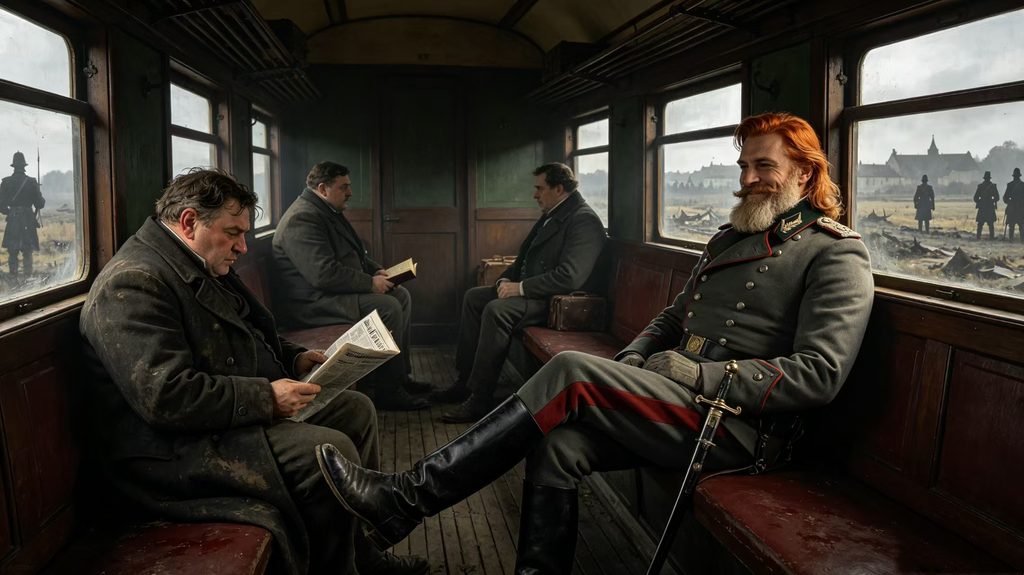
In the same railway carriage were two Englishmen,
who had come to the country as sightseers
and were gazing about them with looks of quiet curiosity.
They were both also stout,
and kept chatting in their own language,
sometimes referring to their guidebook,
and reading aloud the names of the places indicated.
Suddenly the train stopped at a little village station,
and a Prussian officer jumped up
with a great clatter of his sabre on the double footboard of the railway carriage.
He was tall,
wore a tight-fitting uniform,
and had whiskers up to his eyes.
His red hair seemed to be on fire,
and his long mustache, of a paler hue,
stuck out on both sides of his face,
which it seemed to cut in two.
The Englishmen at once began staring at him
with smiles of newly awakened interest,
while M. Dubuis made a show of reading a newspaper.
He sat concealed in his corner
like a thief in presence of a gendarme.
The train started again.
The Englishmen went on chatting
and looking out for the exact scene of different battles;
and all of a sudden,
as one of them stretched out his arm toward the horizon
as he pointed out a village,
the Prussian officer remarked in French,
extending his long legs and lolling backward:
“I killed a dozen Frenchmen in that village and took more than a hundred prisoners.”
The Englishmen, quite interested, immediately asked:
“Ha! and what is the name of this village?”
The Prussian replied:
“Pharsbourg.”
He added:
“We caught those French scoundrels by the ears.”
And he glanced toward M. Dubuis,
laughing conceitedly into his mustache.
The train rolled on,
still passing through hamlets occupied by the victorious army.
German soldiers could be seen along the roads,
on the edges of fields,
standing in front of gates or chatting outside cafes.
They covered the soil like African locusts.
The officer said, with a wave of his hand:
“If I had been in command,
I’d have taken Paris, burned everything, killed everybody.
No more France!”
The Englishman, through politeness, replied simply:
“Ah! yes.”
He went on:
“In twenty years all Europe, all of it, will belong to us.
Prussia is more than a match for all of them.”
The Englishmen, getting uneasy, no longer replied.
Their faces, which had become impassive,
seemed made of wax behind their long whiskers.
Then the Prussian officer began to laugh.
And still, lolling back, he began to sneer.
He sneered at the downfall of France,
insulted the prostrate enemy;
he sneered at Austria, which had been recently conquered;
he sneered at the valiant but fruitless defence of the departments;
he sneered at the Garde Mobile and at the useless artillery.
He announced that Bismarck was going to build a city of iron
with the captured cannon.
And suddenly he placed his boots against the thigh of M. Dubuis,
who turned away his eyes,
reddening to the roots of his hair.
译文
战争结束了。
德军占领了法国。
整个国家如同落败的摔跤手,
匍匐在胜利者的威压之下,瑟瑟颤抖。
从满目疮痍、饥寒交迫的巴黎驶出的列车,
缓缓驶向新的边境,
穿行在一片片乡村与小镇之间。
乘客透过车窗眺望,
只见田野残破、村落焚毁,遍地皆是战争痕迹。
普鲁士士兵头戴铜尖黑头盔,
闲散坐在留存的房屋门前抽着烟斗,
俨然一副主人的姿态。
士兵们自由劳作、闲谈,
仿佛这片土地本就属于他们。
行经各个城镇,
广场上随处可见操练的普鲁士军团,
车轮滚滚轰鸣,
耳畔始终回荡着粗哑的军令声。
迪比先生曾在巴黎围城战中担任国民自卫军,
如今动身前往边境,
奔赴瑞士与战前安顿好的妻女团聚。
富足温和的商人生活,
让他身形富态,并未被饥荒苦难摧垮。
历经一年的战乱与磨难,
他满心悲凉,默默承受世事无常,
愤慨着战争与人性的野蛮残酷。
战事落幕,这是他第一次直面侵略者,
即便他曾坚守城墙、寒夜站岗,
为祖国拼尽全力,从未退缩。
望着遍布国土、肆意横行的敌军士兵,
他心中交织着恐惧与愤怒。
心底翻涌着无力的爱国热忱,
同时生出历经战乱后的审慎与隐忍,
这份心境,自此深深烙印在心底。
车厢内两名英国观光客,
带着淡然的好奇打量着沿途景象,
身形魁梧,低声闲谈,
不时翻阅旅行手册,念出沿途地名。
列车停靠乡村小站,
一名普鲁士军官猛地起身,
军刀撞击踏板,发出刺耳的金属脆响。
他身形高挑、军装紧绷,
络腮胡须贴近眉眼,红发张扬似火,
浅色长须向两侧延展,
将整张脸庞割裂开来,神态嚣张凌厉。
英国人饶有兴致地注视着他,
迪比先生却佯装看报,蜷缩在角落,
如同罪人面对执法者,满心拘谨与屈辱。
列车再度启程。
英国人继续闲谈,探寻古战场遗迹。
一人抬手指向远方村落,
普鲁士军官慵懒后仰、舒展长腿,
用法语傲慢吹嘘:
“我在那座村子斩杀十几名法国人,俘虏百人有余。”
英国人好奇追问村落名称,
军官傲然答道是法尔斯堡,
还轻蔑嘲讽法军懦弱不堪、不堪一击,
侧眼睨视迪比先生,满脸狂妄戏谑。
列车一路前行,
途经无数被德军占领的村落。
道路、田埂、门前、街边咖啡馆外,
随处可见驻守的德军士兵,
密密麻麻,如同肆虐的蝗虫铺满大地。
军官肆意妄言,
声称若由他统领军队,
定会踏平巴黎、焚毁一切、灭绝法国。
英国人碍于礼貌淡淡附和,
军官愈发狂妄,扬言二十年内,
普鲁士将一统整个欧洲,无人能敌。
英国人面露局促、闭口不言,
长须下的面容僵硬冰冷,再无笑意。
军官肆意嘲讽法国的战败落魄,
羞辱俯首认输的法兰西民族,
讥笑战败的奥地利、徒劳抵抗的法军,
蔑视所有为祖国奋力抗争的普通人。
他狂妄宣称,要用缴获的火炮,
打造一座钢铁城池,彰显普鲁士的战功。
他肆意将靴子抵在迪比先生腿上,
极尽羞辱,令迪比先生满脸通红、隐忍难堪。
🔍长难句赏析与拆解
原句:
He stared with mingled fear and anger
at those bearded armed men, installed all over French soil as if they were at home,
and he felt in his soul a kind of fever of impotent patriotism,
at the same time also the great need of that new instinct of prudence
which since then has never left us.
句式解读:
本句为高级并列复合句,句式层次丰富规整。
前半句描写人物外在动作,后半句刻画内心情绪。
插入后置定语、方式状语、定语从句多重结构,
将环境、动作、心理融为一体,叙事细腻高级。
句子主干:
He stared at those men and he felt patriotism and prudence.
原句:
And suddenly he placed his boots against the thigh of M. Dubuis,
who turned away his eyes, reddening to the roots of his hair.
句式解读:
经典主句+非限制性定语从句结构。
后半句搭配现在分词作伴随状语,
同步刻画人物神态与心理,
动作连贯、画面鲜活、情绪饱满。
句子主干:
He placed his boots against the thigh of M. Dubuis.
文学赏析
《决斗》是莫泊桑普法战争题材的经典短篇。
文章摒弃宏大惨烈的战场厮杀描写,
以战后普通列车车厢为狭小叙事场景,
以小见大,折射整个民族的屈辱与抗争。
主人公迪比是温和富足的普通商人,
天性热爱和平、隐忍退让、厌恶纷争。
战乱之中,他坚守本分、保全家眷、为国尽责,
只求战乱落幕、安稳度日。
面对普鲁士军官无休止的傲慢、嘲讽与刻意羞辱,
他一次次隐忍、退让、压抑怒火。
作者层层铺垫冲突,
细致刻画弱者在强权压迫下的卑微与煎熬。
全篇没有激昂的抒情、刻意的煽情,
只用冷静克制的客观叙事推进情节。
以侵略者的狂妄跋扈,
反衬普通人深藏心底的家国傲骨。
文章深刻诠释了核心主旨:
真正的尊严从不由武力强弱决定。
温顺的凡人亦有不可触碰的民族底线,
隐忍的普通人,被逼至绝境,
亦能迸发捍卫家国的磅礴勇气。
写作迁移点拨
适合写作主题:隐忍与反抗、尊严不可践踏、
家国风骨、傲慢的代价、弱者的力量。
高分仿写:
True dignity never comes from superior force.
Even quiet, ordinary people will stand up
when their homeland and self-respect are insulted.
仿写运用:
模仿原文含蓄克制的表达,
适合写尊严、家国、反抗类记叙文结尾升华。
📖全篇句式特点
以平缓的陈述句为主,多用分词、定语从句刻画环境、心理,
对话不多,依靠动作、神态、细节烘托矛盾;
文字朴素克制,不刻意渲染悲愤,
冲突藏在平静叙事之下,留白感极强。
核心词汇
1. pulsate
/ˈpʌlseɪt/
悸动,搏动
动词 (v.)
2. ravaged
/ˈrævɪdʒd/
惨遭蹂躏的
形容词 (adj.)
3. hoarse
/hɔːs/
沙哑的,粗哑的
形容词 (adj.)
4. prudently
/ˈpruːdəntli/
谨慎稳妥地
副词 (adv.)
5. resignation
/ˌrezɪɡˈneɪʃn/
顺从,隐忍
名词 (n.)
6. impotent
/ˈɪmpətənt/
无力的,徒劳的
形容词 (adj.)
7. prudence
/ˈpruːdns/
审慎,谨慎
名词 (n.)
8. conceited
/kənˈsiːtɪd/
狂妄自大的
形容词 (adj.)
9. sneer
/snɪə(r)/
嘲讽,鄙夷
动词 (v.)
10. valiant
/ˈvæliənt/
英勇的,果敢的
形容词 (adj.)
💡主旨品读
这场故事里的决斗,不是刀枪相向的厮杀,
而是普通百姓的骨气与侵略者傲慢之间的对峙。
战败的国土被占领,屈辱如影随形,
退让换不来尊重,一味隐忍只会招来变本加厉的冒犯。
莫泊桑借着一个商人的抉择告诉我们:
民族尊严根植在每个普通人心里。
外表温和、与世无争的人,
也有着不容触碰的底线。
真正的勇敢未必是主动挑起争斗,
而是在尊严被践踏时,守住本心,奋起反抗。
和平与退让是选择,捍卫尊严是本能。
©英语数字智库 版权所有
未经权利人许可,不得转载、摘抄、复制、
二次编辑或商用分发,违者将依法追究法律责任。
请点击返回首页收录经典目录