
 由 英语数字智库
了解更多:雅思:人文与心理类话题词汇目录
Hell Screen《地狱变》
作者:芥川龙之介(Ryūnosuke Akutagawa)
首次出版:1918 年 5 月(大正 7 年 5 月)
首次发表刊物:《大阪每日新闻》
收录信息:1918 年 10 月由新潮社收入《傀儡师》,
后收入《罗生门》全集
出版背景:原版刊印,后世多次校勘再版。
多国译本与双语选编版本广泛流传。
收录说明:
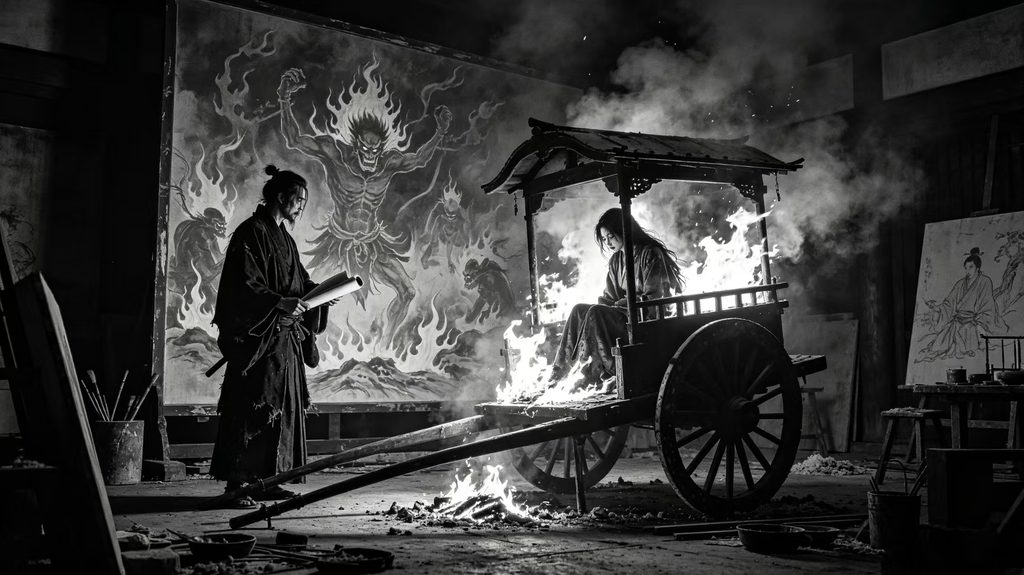
权倾一时的大公命令画师良秀绘制一幅地狱变屏风。
良秀性情乖戾偏执,唯独深爱自己的女儿。
为画出真实的地狱景象,他不惜目睹残酷的烈火酷刑。
当亲眼看见女儿被囚车焚烧,他在剧痛中完成绝世画作。
一幅震撼人心的地狱图背后,是艺术、人性与牺牲的悲剧。
创作背景:
故事取材于平安时代传说集
《今昔物语集》卷二十九《震旦国画师于壁上画地狱事》。
芥川龙之介借古代画师的故事,拷问艺术与人性的边界。
为追求极致艺术,人是否可以容忍乃至献祭一切珍贵之物。
英文原文
Deep in the decaying capital of Kyoto,
amid the ruins of once-grand aristocratic estates
and the silent alleys where plague and famine had left their mark,
there lived a painter named Yoshihide.
He was not a man of gentle manners,
nor did he seek the company of nobles for advancement.
What set him apart from all other artists
was a terrible, unyielding obsession:
to capture on paper and screen
the very face of hell,
not as a distant religious legend,
but as a living, burning reality that could be seen and suffered.
Yoshihide’s reputation had spread through the capital,
yet few people spoke of him with warmth.
Some called him a genius.
Others called him inhuman.
He would stare at condemned prisoners with the eye of a painter,
not with the heart of a man.
He sketched suffering as if it were merely light and shadow,
as if pain itself were nothing more
than a powerful brushstroke to be studied and recorded.
His most powerful patron was the Lord of Horikawa,
a nobleman whose word was law
and whose anger could turn a courtyard into ashes.
The lord commanded Yoshihide to paint a great screen
depicting the Buddhist hell in all its terror.
It was to be no ordinary religious image.
It must contain fire, demons, falling souls,
and the most dreadful agony any artist had ever dared to show.
Yoshihide accepted the order without hesitation.
But from the beginning, he was dissatisfied.
He had read the old sutras and hell scrolls.
He had copied the figures of demons and burning lakes.
Yet none of it felt true enough.
A painter who had never actually seen hell,
he believed, could never make others feel it.
So he began to seek reality wherever it could be found.
He watched criminals being tortured at the execution ground.
He wandered through plague-stricken streets
where the dying lay unattended.
He sketched crows feeding on abandoned bodies
and the cold faces of officials who turned away.
His pupils grew afraid of him.
His neighbours locked their doors when he passed.
Even the servants in Horikawa’s palace
whispered that he was no longer entirely human.
As the months passed,
the Hell Screen slowly took shape.
Demons leaped from the brush.
Flames roared across the paper.
Mountains of iron and lakes of blood
appeared so vivid that some viewers shuddered.
But Yoshihide was still not satisfied.
The centre of the screen remained empty.
He could imagine a woman burning,
but he could not paint the exact moment
when human dignity turns to ash.
Night after night, he sat before the blank space,
his brush hovering, his mind in torment.
He began to look at his own daughter
with a strange, cold gaze.
She was the only living thing he loved,
and perhaps for that very reason,
she had become the final obstacle in his art.
At last, the Lord of Horikawa summoned him.
A hidden courtyard had been prepared.
Inside it stood an ancient carriage,
and bound within the carriage was Yoshihide’s own daughter.
The lord had ordered the carriage set ablaze
so that the painter might finally see
the perfect horror he had been chasing.
When the flames rose,
Yoshihide did not move forward.
He did not cry out.
He stood as if turned to stone,
his eyes fixed on the burning carriage.
At first, there was only grief in his face.
Then, slowly, another expression appeared:
the terrible, transfiguring rapture of an artist
who has at last beheld the truth he had long pursued.
The fire burned for hours.
When it ended,
nothing remained of the carriage
but blackened wood and cold ash.
Yoshihide returned to his studio
and began to paint the central scene.
His brush moved like a man possessed.
Flames, smoke, agony, and terror
flowed from his hand as if they had been waiting there all along.
In a single night, the Hell Screen was complete.
It surpassed every expectation.
Those who saw it said they could feel the heat of the flames,
hear the screams of the damned,
and smell the burning flesh and hair.
It was no longer merely a painting.
It had become a doorway into another world.
Yet no one who admired the screen
could remain entirely at ease.
For beneath all its beauty and terror,
there lay a terrible secret:
the greatest masterpiece of hell
had been bought not with imagination alone,
but with the life of the painter’s own child.
Shortly after finishing the work,
Yoshihide hanged himself from a cedar tree
near the ruins of his old studio.
Some said he died of guilt.
Others said he died because,
having once seen the truest horror,
he could no longer bear the ordinary world.
Whatever the reason,
the Hell Screen remained behind,
a monument both to artistic greatness
and to the dreadful cost of seeing reality too clearly.
译文
在破败衰落的京都城中,
在昔日宏伟贵族宅邸的废墟之间,
在瘟疫与饥荒留下死寂痕迹的街巷深处,
曾住着一位名叫良秀的画师。
他并非性情温厚之人,
也从不为了仕途而刻意结交贵族。
他与其他艺术家截然不同之处,
在于一种可怕而执拗的执念:
要在纸本与屏风之上描绘地狱的真面目,
不是把它当作遥远的宗教传说,
而是当作可见、可感、可受苦的燃烧现实。
良秀的声名早已传遍京城,
但很少有人带着暖意谈起他。
有人称他为天才,
也有人称他不近人情。
他会以画师的眼光凝视死刑犯,
而不是以常人的心灵感受他们。
他记录苦难,仿佛苦难只是光与影,
仿佛痛苦本身,
也不过是值得研究与摹写的一笔浓墨。
他最有权势的主顾是堀川大人,
这位贵族一言九鼎,
其怒火足以将庭院化为灰烬。
主公命良秀绘制一幅大型屏风,
将佛教地狱的恐怖尽数呈现。
这并非普通宗教图像,
而必须包含烈火、恶鬼、堕落的灵魂,
以及任何艺术家都敢于表现的最深痛苦。
良秀毫不犹豫地接受了命令。
但从一开始,他便不满意。
他读过古老经文与地狱卷轴,
临摹过恶鬼与血海图像。
然而没有一幅足够真实。
一个从未真正见过地狱的画家,
他相信,永远无法让他人感受到地狱。
于是他开始一切可能之处寻找真实。
他在刑场观看犯人受刑,
在瘟疫横行的街道徘徊,
看无人照管的濒死者躺在路边。
他画乌鸦啄食弃尸,
画官员冷漠转身的面孔。
他的弟子开始惧怕他,
邻居在他经过时紧闭门窗,
就连堀川府中的仆役也低声议论,
说他已经不再完全是人。
数月过去,《地狱变》逐渐成形。
恶鬼从笔底跃出,
火焰在纸面咆哮,
铁山与血海栩栩如生,
令观者不寒而栗。
但良秀仍不满足。
画面中央始终空着。
他能够想象一名女子被焚烧,
却无法画出
人的尊严化为灰烬的那个精确瞬间。
一夜又一夜,他坐在空白处前,
画笔悬停,内心备受煎熬。
他开始以奇异而冰冷的目光注视自己的女儿。
她是他唯一爱过的生命,
也许正因为如此,
她才成了他艺术最后的障碍。
终于,堀川大人召见了他。
一座隐秘庭院已被备好,
院中停着一辆古老马车,
而被缚在车内的,
正是良秀的亲生女儿。
主公下令点燃马车,
只为让画师终于看见
他一直追逐的那种完美恐怖。
火焰升起时,良秀没有上前。
他没有呼喊。
他站着,仿佛化为石像,
目光牢牢锁定燃烧的马车。
起初,脸上只有悲痛。
随后,另一种神情慢慢浮现:
那是一位艺术家终于望见
长久追寻的真实时,
所产生的可怕而变形的狂喜。
大火燃烧了数个时辰。
结束时,
马车只剩焦黑木架与冰冷灰烬。
良秀回到画室,
开始绘制中央场景。
他落笔如有神助,
火焰、浓烟、痛苦与恐惧,
仿佛早就在他笔端等待,
此刻尽数奔涌而出。
一夜之间,《地狱变》大功告成。
它超出了所有人的预期。
见过的人都说,
能感到火焰的热浪,
听见罪人的惨叫,
闻到烧焦的皮肉与发丝的气味。
它已不再仅仅是一幅画,
而成为通向另一个世界的入口。
然而,无论多么赞叹这幅屏风,
没有人能够真正心安。
因为在其壮美与恐怖之下,
藏着一个可怕的秘密:
这幅最伟大的地狱杰作,
并非仅靠想象完成,
而是以画师亲生女儿的生命为代价换来。
作品完成后不久,
良秀在旧画室附近的杉树上自缢。
有人说他死于愧疚,
也有人说他死于
见过最真实的恐怖之后,
再也无法忍受寻常人世。
无论原因如何,
《地狱变》终究留存下来,
成为艺术伟大的纪念碑,
也成为过度看清真实之后
所必须付出的可怕代价。
🔍长难句赏析与拆解
原句一
What set him apart from all other artists
was a terrible, unyielding obsession:
to capture on paper and screen
the very face of hell,
not as a distant religious legend,
but as a living, burning reality that could be seen and suffered.
句式解读
本句以 what 引导主语从句开篇,
强调良秀与普通画家的本质差异。
冒号后用不定式结构展开 obsession 的具体内容,
not…but… 形成价值判断上的强对比,
将“宗教传说”与“可感现实”对立起来。
that 引导定语从句收束语义,
把抽象艺术追求落到可见、可受的真实层面。
句子主干:
What set him apart was an obsession.
原句二
At first, there was only grief in his face.
Then, slowly, another expression appeared:
the terrible, transfiguring rapture of an artist
who has at last beheld the truth he had long pursued.
句式解读
前句以 there be 句型建立人物初始情绪,
节奏平缓,为后文反转蓄势。
后句冒号后对 rapture 进行同位解释,
并用 terrible、transfiguring 形成反差修饰,
点明良秀在极端痛苦中的精神变形。
who 引导定语从句,
将个人悲剧升华为艺术主体对“真实”的终极抵达。
句子主干:
There was grief. Another expression appeared.
📖全篇句式特点
本文采用“传说式叙述 + 人物心理特写”的结构。
开篇多用客观、平缓的长句铺陈良秀的怪异声名,
中段以短句切割关键场景,
尤其在火焚车中女一幕,
用停顿制造近乎静默的视觉张力。
全文节奏由缓到急,
再在结尾骤然回落。
作者不直接评判良秀的善恶,
而以旁观者口吻记录其行为与后果,
形成冷峻、神秘、近于能剧式的舞台效果。
核心词汇
1. decay
/dɪˈkeɪ/
衰落,腐朽
动词(v.)/ 名词(n.)
2. obsession
/əbˈseʃn/
痴迷,执念
名词(n.)
3. patron
/ˈpeɪtrən/
赞助人,主顾
名词(n.)
4. torment
/ˈtɔːment/
折磨,痛苦
名词(n.)
5. withdrawal
/wɪðˈdrɔːəl/
孤僻,离群
名词(n.)
6. rapture
/ˈræptʃə(r)/
狂喜,痴迷
名词(n.)
7. screen
/skriːn/
屏风
名词(n.)
8. suicide
/ˈsuːɪsaɪd/
自杀
名词(n.)
💡主旨品读
《地狱变》的核心,
不是简单讲述艺术家的残酷,
而是追问“真实”是否必须以生命为代价。
良秀眼中的美,
不是世俗意义的漂亮,
而是包含痛苦、死亡与恐惧在内的绝对真实。
为了画出地狱,
他必须先让自己坠入地狱。
良秀与堀川大人的关系,
是权力与艺术的博弈。
主公能支配现实,
却无法支配良秀眼中的真实;
良秀能描绘地狱,
却无力保护自己最亲的人。
当艺术追求越过伦理边界,
最终吞噬的,
往往是创作者本人。
©英语数字智库 版权所有
未经权利人许可,不得转载、摘抄、复制、
二次编辑或商用分发,违者将依法追究法律责任。
请点击返回首页收录经典目录